Realty Group

Ala Moana.

Walk-to-the-beach, walk-to-the-mall Honolulu.

Between Waikiki and Kakaʻako, anchored by the country's largest open-air shopping center to the north and one of Oahu's best urban beaches to the south, Ala Moana is the Honolulu condo neighborhood where you can leave your car parked for a week and not miss it. Towers built between 1968 and 2024 sit on the same blocks. They look comparable on a unit listing. They are not.

What separates a good Ala Moana buy from a costly one isn't the unit. It's the building underneath it.

The Big Picture

What Ala Moana actually is.

Ala Moana sits roughly between Ward Avenue (west, where it meets Kakaʻako), Kalakaua Avenue / Kapiolani Park (east, where it meets Waikiki and Diamond Head), Kapiolani Boulevard (north), and the ocean (south). The Ala Wai Canal runs along the eastern edge, separating Ala Moana from Waikiki. The Ala Moana Boulevard arterial cuts through the middle, parallel to the coastline.

The neighborhood is named for — and effectively organized around — two anchors. Ala Moana Center, opened in 1959 and continuously expanded since, is the largest open-air shopping center in the world by gross leasable area, with Macy's, Bloomingdale's, Nordstrom, Saks, Neiman Marcus, and roughly 350 other stores and restaurants. Ala Moana Beach Park, opened in 1934, is the urban beach of Honolulu — a half-mile of protected sand, the Magic Island peninsula, and a calm-water swim area inside the reef.

The mix today: roughly 95% high-rise condo, 4% low-rise condo, less than 1% single-family. Towers were built across a 55-year span — Yacht Harbor Towers (1973), Discovery Bay (1979), Nauru Tower (1995), Hawaiki Tower (2000), Hokua (2007), One Ala Moana (2014), Park Lane (2017) — and they coexist on the same blocks. The age spread matters more than buyers realize.

The Market

Ala Moana market at a glance.

Median Condo Sale Price

Updating

Metro region · all condos

Days on Market (median)

Updating

Metro region · all condos

Price per Sq Ft (median)

Updating

Metro region · all condos

Months of Supply

Updating

Balanced market = 4–6 months

Source: HiCentral MLS via InfoSpark, Metro region (includes Ala Moana with Kakaʻako, Waikiki, and downtown). Refreshed monthly. Note: building-specific data tells the more useful story.

The Inventory

The buildings, the basics.

Ala Moana's reputation comes from a small number of marquee buildings, but the day-to-day condo market here runs across 30+ towers built across 55 years. Here are the ones you'll encounter most often, organized by tier and era — with the carrying-cost reality each building's age implies.

Park Lane Ala Moana (2017)

Trophy luxury · 219 units · Ocean + Diamond Head views · No retrofit exposure

The high-water mark of Ala Moana luxury. Eight-story luxury residence built around a private garden, integrated with Ala Moana Center. Pricing typically $5M–$20M+. New construction means modern fire-suppression baseline, lower HOA-to-purchase-price ratio, and no Ordinance 18-14 exposure. Park Lane behaves more like a Kahala-tier asset than a typical Ala Moana condo.

One Ala Moana (2014)

Upper-luxury · 215 units · Ocean + mountain views · No retrofit exposure

The 23-story luxury condo built atop Ala Moana Center's western edge. Direct mall integration, full-service amenities (concierge, pool, fitness). Pricing typically $1.5M–$5M+. Same modern-construction baseline as Park Lane on the HOA-and-safety side — buyers can underwrite this building without worrying about retrofit assessments.

Hokua (2007)

Upper-luxury · 247 units · Ocean + Magic Island views · No retrofit exposure

40-story tower with direct Magic Island and Ala Moana Beach Park frontage. One of the strongest park-front view orientations in the neighborhood. Pricing typically $1.5M–$5M. Built after 1975, so not subject to Ordinance 18-14 — same advantage as the newer buildings.

Hawaiki Tower (2000)

Mid-luxury · 418 units · Ocean + mountain views · No retrofit exposure

Large 45-story tower mid-block, two-bedrooms are the bread-and-butter. Pricing typically $700K–$1.5M. Newer-construction era with relatively modest HOA fees relative to amenity set.

Nauru Tower (1995)

Mid-luxury · 257 units · Ocean + Magic Island views · No retrofit exposure

40-story park-front tower with strong view orientation and one of the better resale-velocity track records in Ala Moana. Pricing typically $700K–$1.8M.

Imperial Plaza (1992)

Mid-market · 215 units · Mountain + city views · No retrofit exposure

30-story interior building, more affordable entry point. Pricing typically $400K–$800K. Limited view inventory but solid building, good location for value-tier buyers.

Discovery Bay (1979)

Mid-market · 668 units · Variable views · Retrofit status: verify

Large two-tower complex at the eastern edge of Ala Moana, near the Hilton Hawaiian Village. Built right at the 1975 line — newer than Ordinance 18-14's primary retrofit target, but verify sprinkler-system status before underwriting. Pricing typically $400K–$900K.

Yacht Harbor Towers (1973)

Mid-market · 484 units · Direct marina + ocean views · Subject to Ord. 18-14 retrofit

Two 40-story marina-front towers, one of the more distinctive Ala Moana view orientations (direct Ala Wai Boat Harbor and ocean). Pricing typically $500K–$1.2M. Built in 1973 — falls within Honolulu Ordinance 18-14's pre-1975 retrofit requirement. The building has been working through sprinkler retrofit planning; ask about special assessment status and current retrofit completion before underwriting.

Ala Moana Hotel Condos (1970)

Mid-market · ~1,150 units · Variable views · Subject to Ord. 18-14 retrofit

Hotel-condo conversion across two towers, transient-allowed for short-term rental in many units. Pricing typically $300K–$700K. Pre-1975 construction — confirm sprinkler retrofit status and consider transient zoning + HOA structure when underwriting investment potential.

1108 Ala Moana (1970)

Mid-market · 360 units · Variable views · Subject to Ord. 18-14 retrofit

One of the older Ala Moana towers, mid-block on Ala Moana Boulevard. Pricing typically $350K–$700K. Pre-1975 — verify retrofit status, current HOA, and any pending special assessments before offer.

Ala Moana Blvd / Atkinson Drive Corridor (1968–1985)

Entry-level to mid · Multiple buildings · Most subject to Ord. 18-14

The cluster of older mid-rise and high-rise buildings along Atkinson Drive and Ala Moana Boulevard (mauka side). Most were built before 1975. Entry-level Ala Moana pricing ($250K–$500K) lives here. Highest exposure to retrofit special assessments in the neighborhood. Building-specific diligence matters most for this tier.

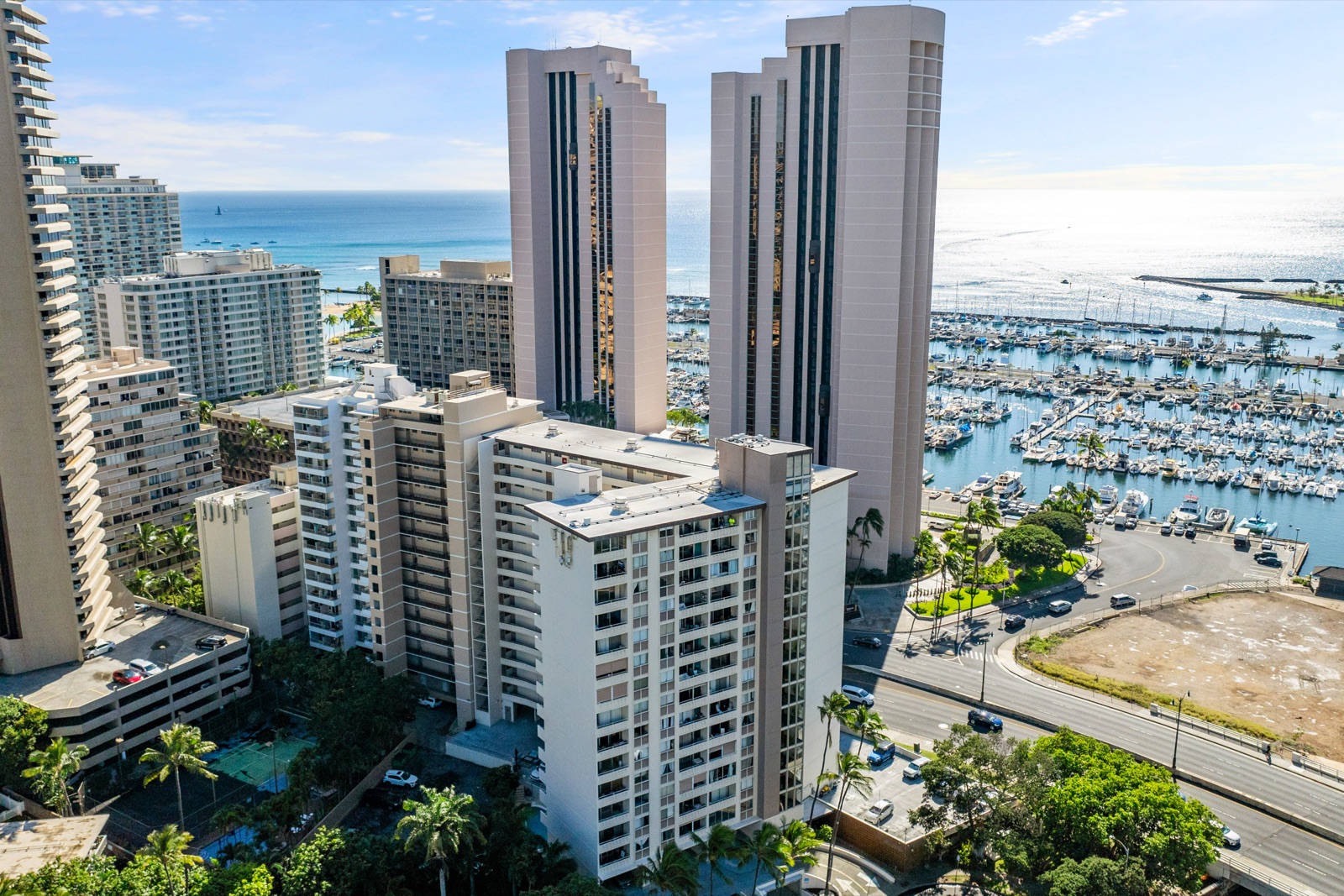
Lifestyle

What it's actually like to live here.

The mall as backyard

Ala Moana Center anchors the neighborhood the way Lēʻahi anchors Diamond Head — except the mall is open 11 AM to 8 PM and you can walk to dinner. Macy's, Bloomingdale's, Nordstrom, Saks, Neiman Marcus, Apple, Williams Sonoma, Foodland Farms, the Ala Moana Whole Foods. The food court alone has 80+ options. For Ala Moana residents, "running an errand" usually means a 5-minute walk. The trade-off: weekend traffic and parking pressure around the Center spill into surrounding streets.

Beach and Magic Island

Ala Moana Beach Park is one of the few protected-water urban beaches in Honolulu. Calm-water swim inside the reef, the half-mile sand stretch, Magic Island's peninsula and pond. The annual Honolulu Marathon finish line is here. Public tennis courts, a softball field, the Ala Moana Bowls surf break (advanced — sits outside the reef). Sunrise yoga on Magic Island, sunset paddle out of the Ala Wai Boat Harbor. Locally-significant: this is where Honolulu families spend Sunday afternoons.

Walkability + transit

Ala Moana is the densest walkable neighborhood in Honolulu outside Waikiki. Most addresses are 5–15 minutes on foot to the mall, the beach park, and a meaningful share of the city's restaurants. The Ala Moana Center transit hub is the largest bus terminal on Oahu (every major city route stops here), and the Honolulu Skyline rail's downtown extension is planned to terminate adjacent to Ala Moana. Many residents don't own a car, or own one and drive it twice a week.

Why This Neighborhood Is Different

The Marco Polo law changed Ala Moana's math.

Most online estimators and most agents from outside this market price Ala Moana condos by floor, view, and square footage. Those matter — but they don't capture the single most important carrying-cost variable: when the building was built.

On July 14, 2017, the Marco Polo Apartments in Makiki — a 1971 high-rise without automatic fire sprinklers in the residential floors — caught fire on the 26th floor. Four people died. The Honolulu City Council passed Ordinance 18-14 in 2018, requiring all residential high-rise buildings 75 feet tall or taller built before 1975 to retrofit automatic fire sprinkler systems throughout. The original compliance deadline was 2034. Buildings that miss the deadline face escalating fines and potential occupancy issues.

Three structural realities shape Ala Moana condo carrying costs in ways most buyers don't see until after they've closed:

1. Pre-1975 buildings are working through retrofit planning right now

A meaningful share of Ala Moana's mid-tier inventory was built between 1968 and 1974 — Yacht Harbor Towers (1973), Ala Moana Hotel Condos (1970), 1108 Ala Moana (1970), and most of the Atkinson/Ala Moana Boulevard corridor towers. These buildings are in active retrofit planning at various stages. Some have completed the work. Some haven't started. Some are mid-design. Retrofit cost typically runs $5,000–$50,000+ per unit depending on building configuration, plumbing risers, and how the special assessment is structured.

2. HOA fees in older Ala Moana buildings often look lower than total cost of ownership

A $700/mo HOA at a 1973 tower without a completed sprinkler retrofit isn't actually $700/mo — it's $700/mo plus whatever special assessment lands in the next 24 months. We pull the building's reserve study, the board's retrofit timeline, and any pending special-assessment ballot before we quote a number on an older Ala Moana unit.

3. Post-1975 buildings have a structural cost advantage

Buildings built after 1975 (Park Lane, One Ala Moana, Hokua, Hawaiki, Nauru, Imperial Plaza) aren't subject to Ordinance 18-14 retrofit requirements. They have modern fire-suppression baselines from original construction. Buyers underwriting two units with similar list prices — one from 1973, one from 2007 — are looking at two different total-cost-of-ownership pictures, even if the monthly HOA fees look comparable today.

This isn't a reason to avoid older Ala Moana buildings. Many are well-managed, have already completed retrofits, and offer real value once you know what you're underwriting. It IS a reason to read the building before you read the unit. We do that work before we let a buyer write an offer.

Recent Activity

What's actually been transacting.

A selection of recent Ala Moana sales — across the tiers, eras, and view orientations.

Luxury

Park Lane / One Ala Moana / Hokua

Representative recent luxury-tier trade ($1.5M+). Useful for buyers underwriting post-2010 modern-construction Ala Moana.

Mid-Tier

Hawaiki / Nauru / Imperial Plaza

Representative recent mid-tier resale ($700K–$1.5M). The volume-driving heart of the Ala Moana condo market — post-1975 construction, no retrofit exposure.

Older Building

Yacht Harbor Towers / 1108 / Ala Moana Blvd Corridor

Representative recent older-building trade. Worth knowing if you're underwriting pre-1975 inventory — retrofit status is the dominant carrying-cost variable.

Refreshed quarterly from MLS sold data.

Is It Right For You?

Ala Moana fits some buyers. Not everyone.

Ala Moana fits you if you…

  • Want urban walkability over a yard
  • Value walking to a beach park + a mall
  • Are okay with high-rise condo living
  • Will diligence the building age + retrofit status
  • Want ocean views from a higher floor
  • Plan to be in Honolulu medium-to-long term
  • Are okay diligencing transient/short-term rental rules per building
  • Want the densest restaurant + retail proximity in Honolulu

Look elsewhere if you…

  • Need a single-family home with land
  • Want a suburban or quieter setting
  • Don't want monthly HOA fees
  • Want to ignore structural carrying-cost questions
  • Need mountain or country quiet
  • Move every 1–2 years (high transaction costs)
  • Don't want to think about condo board policies
  • Prefer Kahala-style residential quiet
Featured Listings

Available now.

IDX integration in progress. Use the link below to browse current Ala Moana inventory across all buildings.

Work With Us

Working Ala Moana with us.

Browse Ala Moana

See every available Ala Moana condo. New listings hit your inbox the day they hit the MLS.

Selling in Ala Moana

A real CMA that reads the building, not just the unit — building age, HOA, retrofit status, view orientation. 24-hour turnaround.

Just want to talk

A 15-minute call. Tell us what you're trying to do; we'll tell you honestly what we think.

FAQs

Common questions about Ala Moana.

What's Ordinance 18-14 and why does it matter for Ala Moana buyers?

Honolulu Ordinance 18-14 was passed by the City Council in 2018, after the 2017 Marco Polo Apartments fire that killed four people in a 1971 high-rise without automatic fire sprinklers. The ordinance requires all residential high-rise buildings 75 feet tall or taller built before 1975 to retrofit automatic fire sprinklers throughout. Many older Ala Moana buildings — Yacht Harbor Towers (1973), 1108 Ala Moana (1970), Ala Moana Hotel Condos (1970), and others — fall under this requirement. Compliance involves significant per-unit cost (typically $5,000–$50,000+ depending on building configuration), usually funded through special assessments on owners. Buyers underwriting a pre-1975 Ala Moana unit should know the building's retrofit status before writing an offer.

How can I tell whether a specific Ala Moana building is subject to retrofit?

Check three things: (a) Year built — buildings built 1975 or later are not subject to Ordinance 18-14. (b) Building height — Ordinance 18-14 applies to high-rises 75 feet tall or taller; very few Ala Moana residential buildings are below that threshold, but it's worth confirming for shorter buildings. (c) Current retrofit status — even pre-1975 buildings may have already completed the retrofit. The building's HOA or property manager should be able to provide retrofit completion documentation. We pull this for our buyers before any offer goes in.

Are HOA fees in Ala Moana high?

They span widely. Newer luxury buildings (Park Lane, One Ala Moana) carry $1,500–$3,000+/month HOA with full concierge, pool, fitness, and management. Mid-tier buildings (Hawaiki, Nauru, Hokua) typically run $600–$1,500/month. Older mid-market buildings range $400–$1,000/month — but the HOA fee alone doesn't capture total carrying cost if a special assessment is pending. The most useful comparison isn't the monthly HOA fee — it's the all-in monthly carrying cost including projected special assessments over the next 5 years.

What's the difference between park-front and mall-front buildings?

Park-front buildings (Park Lane, Hokua, Nauru Tower, Yacht Harbor Towers) face Ala Moana Beach Park and Magic Island. Premium for ocean and Diamond Head view orientation, generally higher pricing per square foot. Mall-front buildings (One Ala Moana, Ala Moana Hotel) face Ala Moana Center, often with strong mountain views, slightly lower view-tier pricing. Interior buildings (Imperial Plaza, the Kapiolani Boulevard corridor) lack premium view orientation but offer better value entry points. View premium typically explains $200K–$1M+ of price difference for otherwise comparable units.

Are there short-term rental restrictions in Ala Moana buildings?

Building-dependent. Some Ala Moana buildings allow legal short-term rental (Ala Moana Hotel Condos is the primary example — transient-allowed by its zoning). Most residential Ala Moana buildings prohibit short-term rentals (less than 30 days) per Honolulu's 2022 Bill 41 short-term-rental ordinance + individual HOA bylaws. Investors evaluating an Ala Moana condo for STR income should verify the building's specific zoning and HOA rules, plus the current state of Bill 41 implementation, before underwriting on rental yield.

Is Ala Moana a good investment for appreciation?

Appreciation history is solid but not spectacular — Ala Moana has tracked broader Oahu condo appreciation since roughly 2010, with some over-performance in marquee buildings (Park Lane, One Ala Moana) due to limited new luxury supply. The bigger appreciation story for Ala Moana over the next 5–10 years is the planned Honolulu Skyline rail terminus adjacent to the neighborhood — once rail reaches Ala Moana (currently planned, on a moving timeline), connectivity and rentability change meaningfully. Worth knowing if you're underwriting on a 10-year hold.

Can I see Diamond Head from any Ala Moana building?

From most upper floors of park-front buildings, yes — Diamond Head sits to the east, visible across the Ala Wai Canal and Waikiki. Hokua, Park Lane upper floors, Nauru Tower, and Yacht Harbor Towers (east-facing units) all have strong Diamond Head views. Mall-front and interior buildings generally don't get Diamond Head views unless they're tall enough to see over the surrounding towers. View clarity is meaningfully affected by floor height — verify the view from the actual unit before underwriting.

What's the parking situation in Ala Moana condos?

Standard for most buildings is one assigned space per unit. Some larger units in luxury buildings include two spaces. Older mid-market buildings may have tandem (one-behind-the-other) configurations rather than side-by-side spaces. Guest parking varies wildly by building — some have generous visitor decks, some require off-site street parking. Ala Moana Center has paid parking that residents sometimes use as overflow. Worth diligencing per-unit, especially for buyers with multiple vehicles.